

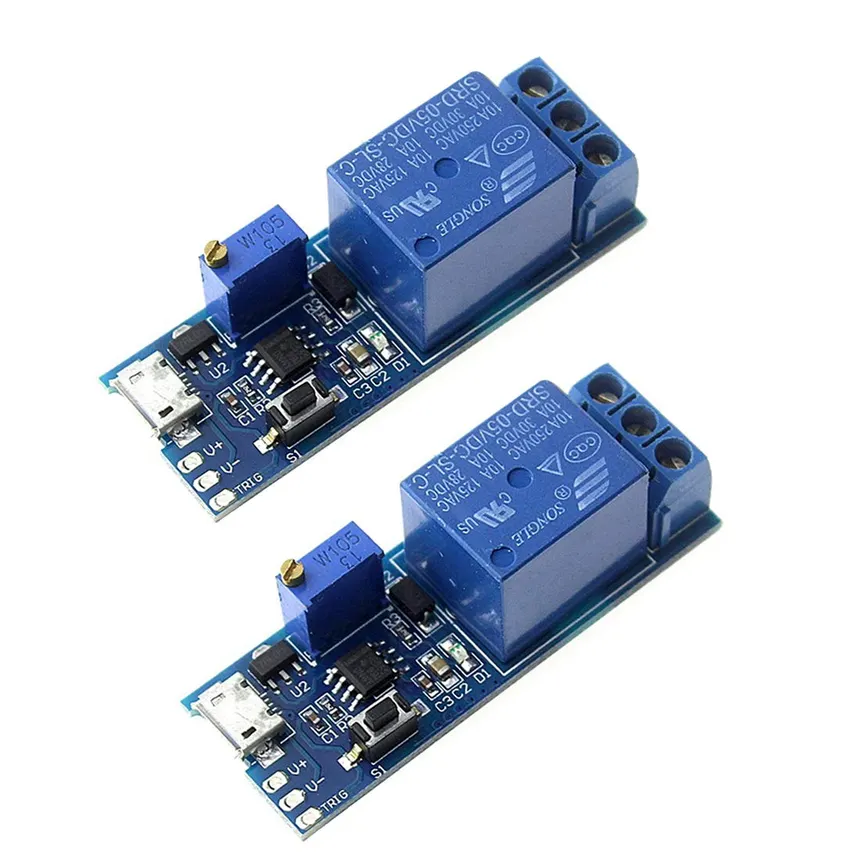
Adjustable Delay Relay Timer Control Module Trigger Delay Switch 5V
170.00 170.00
The Adjustable Delay Relay Timer Control Module Trigger Delay Switch 5V facilitates precise temporal control over electrical loads through an adjustable potentiometer and signal trigger mechanism. Key Technical Specifications (Datasheet Snapshot) Supply Voltage: Five Volts Direct Current Timing Adjustment Range: Zero to Twenty-Four Seconds Relay Contact Rating: Ten Amperes at Two Hundred Fifty Volts Alternating Current Trigger Method: High Level Logic Input
- AVAILABILITY: AVAILABLE
- SKU: 108
The Adjustable Delay Relay Timer Control Module Trigger Delay Switch 5V is an integrated timing solution engineered for automation and power management applications. This module utilizes a monostable multivibrator configuration to toggle a high-power relay for a duration determined by the onboard variable resistor. Upon receiving a high-level trigger signal, the relay energizes immediately and remains active until the set time interval elapses. This functionality ensures consistent performance in industrial environments and consumer electronics where timed sequences are required.
The circuit design prioritizes stability and protection. The heavy-duty relay contacts are capable of switching both alternating current and direct current loads, providing broad compatibility with lighting systems, electric motors, and solenoid valves.
Key Technical Specifications (Datasheet Snapshot) • Control Voltage: Five Volts Direct Current • Trigger Signal Level: High Level Logic • Maximum Load Current: Ten Amperes • Contact Configuration: Single Pole Double Throw • Response Time: Twenty Milliseconds
The module interface includes a voltage input terminal for the positive supply and a ground terminal for the return path. The trigger section consists of a dedicated signal input terminal. On the output side, the device provides a common terminal alongside a normally open contact and a normally closed contact to support various circuit logic requirements.